
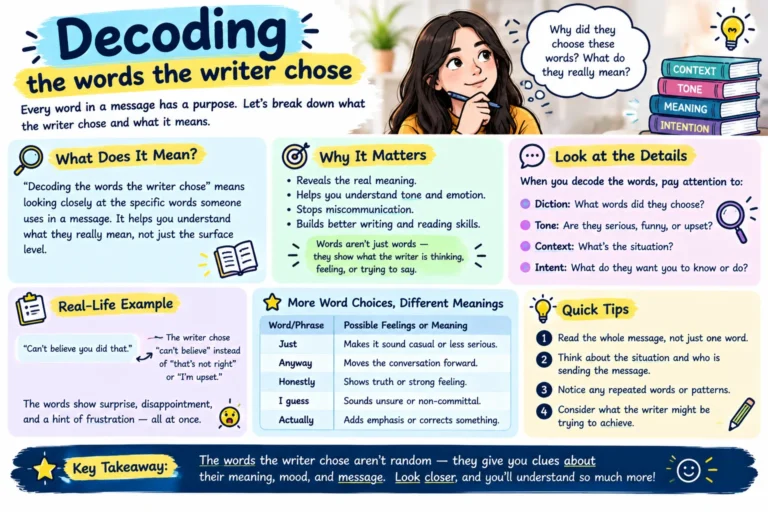
When people search for “decoding meaning in text,” they usually want to know how to understand what a written message really means.
Decoding text means turning written words, symbols, tone, context, and clues into a clear message. It matters because the literal words aren’t always the whole story—especially in texts, social media posts, schoolwork, and online chats.
Quick Answer
| Detail | Answer |
|---|---|
| Meaning | Understanding and interpreting the message in written text |
| Full Form | Not an abbreviation; “decoding” is a normal word |
| Pronunciation | dee-KOH-ding |
| Category | Reading, language, communication, and interpretation |
| Tone | Neutral and educational |
| Used On | Books, messages, social media, schoolwork, websites, chats, and documents |
| Difficulty Level | Beginner to advanced, depending on the text |
| One-line definition | Decoding meaning in text is the process of figuring out what written words are communicating |
What Does “Decoding Meaning in Text” Mean?
Decoding meaning in text means working out the message a writer is trying to communicate.
At the simplest level, decoding involves reading words and understanding their meaning. But good decoding goes further. You may also need to look at:
- The words the writer chose
- The sentence structure
- The situation
- The writer’s tone
- What came before and after
- Emojis, punctuation, or symbols
- Cultural or social context
- What the writer may be implying
For example, someone might text:
“Wow. Nice.”
The literal words sound positive. But depending on the situation, the message could be sincere praise or sarcasm.
That is why decoding text is more than simply reading words. It means understanding the message in context.
Decoding vs. Reading: What’s the Difference?
Reading and decoding are closely related, but they’re not exactly the same.
Reading is the broader process of looking at and understanding written language.
Decoding is the process of converting written signs, words, phrases, and clues into meaning.
For example, if you read:
“The dog ran across the road.”
You decode the words and understand that a dog moved from one side of the road to the other.
In a more difficult sentence, decoding may require additional reasoning:
“He finally broke the ice.”
You need to recognize that “broke the ice” is an idiom. It usually doesn’t mean that someone literally smashed ice. It can mean that someone made people feel more comfortable in a social situation.
So, decoding can involve both language skills and interpretation.
How Do You Decode Meaning in Text?
A simple way to decode almost any text is to move through it step by step.
1. Read the Whole Message
Don’t decide what a sentence means after seeing only one word.
Read the surrounding text first.
For example:
“I can’t believe you did that 😂”
This could be angry, shocked, amused, or playful. The emoji and previous conversation may change the meaning.
2. Identify the Literal Meaning
Start with what the words directly say.
Ask:
“What does this sentence say on the surface?”
This gives you a starting point before you look for hidden meaning.
3. Look at the Context
Context is often the key to decoding meaning.
Consider:
- Who wrote it?
- Who received it?
- What were they discussing?
- What happened before the message?
- Where was it posted?
- What is the relationship between the people?
The same sentence can mean different things in different situations.
4. Notice Tone
Tone describes the attitude or feeling behind the words.
A message can sound:
- Friendly
- Serious
- Angry
- Excited
- Sad
- Sarcastic
- Formal
- Playful
- Romantic
- Dismissive
Written text can be tricky because you can’t hear the speaker’s voice or see their facial expression.
5. Look for Implied Meaning
Sometimes a writer doesn’t say something directly.
Consider:
“It’s getting pretty cold in here.”
The literal meaning is that the room is cold.
But in some situations, the speaker may actually be asking someone to close a window or turn up the heat.
The implied meaning depends on the context.
6. Check for Figurative Language
Writers often use language that isn’t meant literally.
Common examples include:
- Idioms
- Metaphors
- Similes
- Sarcasm
- Hyperbole
- Irony
For example:
“I’ve told you a million times.”
The writer probably doesn’t mean exactly one million times. It’s an exaggeration used to show frustration.
7. Consider the Writer’s Purpose
Ask what the writer is trying to do.
Are they trying to:
- Inform?
- Persuade?
- Entertain?
- Ask a question?
- Give instructions?
- Express emotion?
- Warn someone?
- Make a joke?
- Start an argument?
Understanding the purpose can make the message much easier to interpret.
Literal Meaning vs. Intended Meaning
One of the most important parts of decoding text is separating what the words literally say from what the writer intends to communicate.
| Type | What it means | Example |
|---|---|---|
| Literal meaning | The direct meaning of the words | “The door is open.” |
| Implied meaning | Something suggested but not directly stated | “It’s noisy in here.” |
| Figurative meaning | A non-literal use of language | “He’s drowning in work.” |
| Contextual meaning | Meaning created by the situation | “Great job” after a mistake may be sarcastic |
A strong reader considers all four when necessary.
Examples of Decoding Meaning in Text
Example 1: A Short Text Message
Message:
“Sure, whatever.”
At first glance, it appears to mean agreement.
But the phrase can also show:
- Annoyance
- Frustration
- Indifference
- Reluctant agreement
If the person normally writes cheerful messages but suddenly sends “Sure, whatever,” the tone may be negative.
What this teaches: Short messages often need context to be understood correctly.
Example 2: An Emoji
Message:
“You actually did it 😂”
The laughing emoji may show amusement rather than literal laughter.
The sentence could mean:
“I can’t believe you actually did that!”
The exact feeling depends on the conversation.
What this teaches: Emojis can add emotional information that words alone don’t provide.
Example 3: Sarcasm
Message:
“Perfect timing.”
Imagine someone arrives several hours late.
The phrase sounds positive, but the situation suggests the opposite.
Decoded meaning: The speaker is probably criticizing the person’s lateness.
What this teaches: Sarcasm can make literal and intended meanings completely different.
Example 4: An Idiom
Message:
“She spilled the beans.”
This usually doesn’t mean that someone dropped a container of beans.
It is an idiom meaning that someone revealed a secret or important information.
What this teaches: Some expressions must be understood as phrases rather than word by word.
Example 5: A School Passage
Text:
“The town built a new park after residents complained about the lack of green space.”
A basic decoding would identify the main facts:
- The town built a park.
- Residents had complained.
- The complaint involved a lack of green space.
- The complaint appears to have influenced the decision.
What this teaches: Decoding academic text often involves identifying relationships between ideas, not just defining individual words.
Why Context Matters So Much
A single sentence can have several meanings when removed from its context.
Consider:
“That’s interesting.”
It could mean genuine curiosity.
It could also mean:
- “I didn’t know that.”
- “I disagree.”
- “That’s surprising.”
- “I’m not sure what to say.”
- “That’s strange.”
Without knowing what happened before and after the sentence, it’s difficult to choose the correct interpretation.
This is especially important in text messages and social media, where people often use very short replies.
Decoding Meaning in Text Messages
Texting creates a special challenge because many communication clues disappear.
When people speak face to face, meaning can come from:
- Voice
- Facial expression
- Body language
- Timing
- Gestures
Text messages usually provide much less information.
For that reason, punctuation and formatting can sometimes affect how a message feels.
Compare:
“Okay”
with:
“Okay!”
and:
“Okay…”
The basic word stays the same, but the perceived tone may change.
However, these signals aren’t universal. One person may use “Okay.” normally, while another person may see the period as cold or annoyed.
Don’t treat one punctuation mark as proof of someone’s emotion. Look at the larger conversation.
Decoding Meaning on Social Media
Social media adds even more context.
A post may include:
- Slang
- Hashtags
- Memes
- GIFs
- Emojis
- Abbreviations
- Inside jokes
- Trending phrases
- Cultural references
A person who doesn’t know the surrounding culture may misunderstand the post.
For example, a meme can contain ordinary words but communicate a completely different idea because of the image, trend, or shared joke.
When decoding social media text, ask:
“What does this mean in this community?”
That’s often more useful than asking only what each individual word means.
Decoding Meaning in Online Gaming Chats
Gaming communities often use shortened words and community-specific language.
For example:
| Term | Common meaning |
|---|---|
| AFK | Away from keyboard |
| GG | Good game |
| GLHF | Good luck, have fun |
| BRB | Be right back |
| NPC | Non-player character; sometimes also used figuratively |
| OP | Often “overpowered,” though it can have other meanings |
The exact meaning can change by game or community.
For example, OP can mean “overpowered” in gaming, but it can also mean “original poster” on some online platforms.
What this teaches: Decoding online language requires knowing both the words and the community using them.
Decoding Meaning in School and Academic Texts
In school, decoding often means understanding more than vocabulary.
Students may need to identify:
- The main idea
- Supporting details
- The author’s purpose
- Cause and effect
- Comparisons
- Inferences
- Evidence
- The meaning of unfamiliar words from context
Consider:
“Although the experiment failed, the researchers learned which method did not work.”
The word “although” signals contrast.
The sentence doesn’t simply say the experiment failed. It also explains that the failure produced useful information.
A good decoder notices these relationships.
Decoding Meaning Through Context Clues
Context clues help readers understand unfamiliar words.
Common types include:
Definition Clues
The text directly explains the word.
“The area was arid, meaning extremely dry.”
The phrase after “meaning” gives the definition.
Example Clues
The writer gives examples.
“Nocturnal animals, such as owls and bats, are active at night.”
The examples help explain nocturnal.
Contrast Clues
The writer shows an opposite idea.
“Unlike his outgoing brother, Tom was reserved.”
The contrast suggests that reserved means quiet or less socially expressive.
Inference Clues
The text doesn’t directly define the word. You work out its meaning from the situation.
This is one of the most important reading skills.
How to Decode Hidden or Implied Meaning
Sometimes people search for the “real meaning” of a text because the writer isn’t being direct.
A useful approach is to separate evidence from guesses.
For example:
“Fine.”
You might think the person is angry.
But unless the surrounding conversation supports that interpretation, you shouldn’t treat anger as a fact.
Instead, say:
“The message may sound annoyed, but the exact tone isn’t certain without more context.”
This is a better way to interpret text because it avoids reading too much into a short message.
Is Decoding Meaning the Same as Reading Between the Lines?
Not exactly.
Reading between the lines usually means identifying information that isn’t directly stated.
Decoding meaning is broader. It can include:
- Understanding words
- Understanding sentences
- Recognizing figurative language
- Identifying tone
- Using context
- Making inferences
- Understanding implied meaning
So, reading between the lines is one part of decoding meaning.
Common Mistakes When Decoding Text
Taking Every Word Literally
Idioms, sarcasm, metaphors, and jokes often aren’t literal.
Ignoring Context
A sentence can change meaning when you see the messages before or after it.
Assuming Tone
Written language doesn’t always reveal emotion clearly.
Overanalyzing Short Messages
A person who says “ok” may simply mean “okay.” Not every short reply contains a hidden message.
Treating Slang as Universal
Online expressions can have different meanings in different communities.
Assuming Your Interpretation Is Certain
When context is limited, several interpretations may be possible.
A careful reader distinguishes between:
What the text clearly says and what the text might suggest.
A Simple Formula for Decoding Text
When you’re unsure what something means, use this five-question method:
- What do the words literally say?
- What was happening when they were written?
- What tone does the message seem to have?
- Is there slang, an idiom, sarcasm, or another special expression?
- What interpretations are supported by the available evidence?
This works for a school passage, a social media post, a text message, or an online conversation.
How to Decode a Difficult Text Quickly
If you need a fast method, try this:
Read → Identify → Contextualize → Infer → Check
Read
Read the complete sentence or passage.
Identify
Find unfamiliar words, unusual phrases, and important details.
Contextualize
Connect the text to the situation.
Infer
Work out what isn’t stated directly.
Check
Ask whether your interpretation fits the entire message.
If it doesn’t, reconsider it.
Conversation Examples
Example: Friendly or Sarcastic?
Alex: “I forgot my homework again.”
Sam: “Great job 😂”
Decoded meaning: Sam probably isn’t seriously praising Alex. The laughing emoji and situation suggest playful sarcasm.
Example: An Unclear Reply
Mia: “Do you want to come with us?”
Noah: “Maybe.”
Decoded meaning: “Maybe” does not guarantee that Noah will come. It could mean uncertainty, hesitation, or a polite way of avoiding a firm answer.
Example: Implied Request
Parent: “The trash is still full.”
Child: “Oh, I didn’t notice.”
Decoded meaning: Depending on the situation, the parent’s statement may function as an indirect request for the child to take out the trash.
The words themselves don’t explicitly say “Take out the trash,” but the context can make the intended request clear.
Frequently Confused Ideas
| Concept | Main idea |
|---|---|
| Decoding | Turning written language and clues into meaning |
| Interpreting | Explaining what a text means or suggests |
| Inferring | Reaching a conclusion from clues |
| Summarizing | Giving the main points briefly |
| Paraphrasing | Restating the same idea in different words |
| Reading between the lines | Finding meaning that isn’t directly stated |
| Analyzing | Examining how and why a text communicates its ideas |
These skills overlap, but they’re not identical.
Why Is Decoding Meaning Important?
Decoding helps people understand communication accurately.
It is useful when:
- Reading instructions
- Studying for exams
- Understanding books
- Reading news
- Interpreting workplace messages
- Understanding jokes
- Following online discussions
- Reading social media
- Understanding text messages
- Learning another language
Strong decoding skills can also prevent unnecessary misunderstandings.
A message that seems rude may simply be brief. A joke may look serious if you miss the context. A phrase that seems strange may be a common idiom.
Frequently Asked Questions
What is the simple meaning of decoding text?
Decoding text means figuring out what written words and messages mean. It can involve understanding vocabulary, context, tone, implied meaning, and figurative language.
What does “decode the text” mean?
“Decode the text” means to carefully examine written information and work out its intended message.
Is decoding the same as understanding?
They’re closely connected, but decoding is the process of turning written symbols and language into meaning. Understanding is the broader result of making sense of that information.
What does decoding mean in reading?
In reading, decoding can refer to recognizing written symbols and words and connecting them with language meaning. In broader reading tasks, it can also involve interpreting the message and using context.
How do you decode a text message?
Read the full conversation, identify the literal meaning, consider the relationship between the people, look for slang or emojis, and consider possible tones. Don’t assume an emotional meaning without enough evidence.
Why can text messages be hard to decode?
Text messages often lack voice tone, facial expressions, and body language. Short replies, punctuation, emojis, slang, and cultural differences can also create multiple possible interpretations.
What is implied meaning in a text?
Implied meaning is an idea that the writer suggests without stating it directly. Readers use context and clues to understand it.
What is the difference between literal and implied meaning?
Literal meaning is what the words directly say. Implied meaning is what the writer suggests through context, tone, or other clues.
Can the same text have different meanings?
Yes. Meaning can change depending on context, culture, tone, the relationship between the people involved, and the purpose of the message.
How can I get better at decoding text?
Read regularly, learn vocabulary in context, pay attention to tone and sentence structure, identify the author’s purpose, and practice explaining both the literal and implied meanings of passages.
Final Takeaway
Decoding meaning in text is the process of turning written words and clues into a clear understanding of a message. It starts with the literal words but may also require context, tone, figurative language, cultural knowledge, and inference.
The most reliable approach is simple: don’t guess from one word or one punctuation mark. Read the whole message, consider the situation, separate facts from assumptions, and choose the interpretation best supported by the text.
That habit is useful everywhere—from school assignments and books to text messages, gaming chats, and social media.
Would you like the next version optimized for Google Discover, featured snippets, or a long-form blog?