
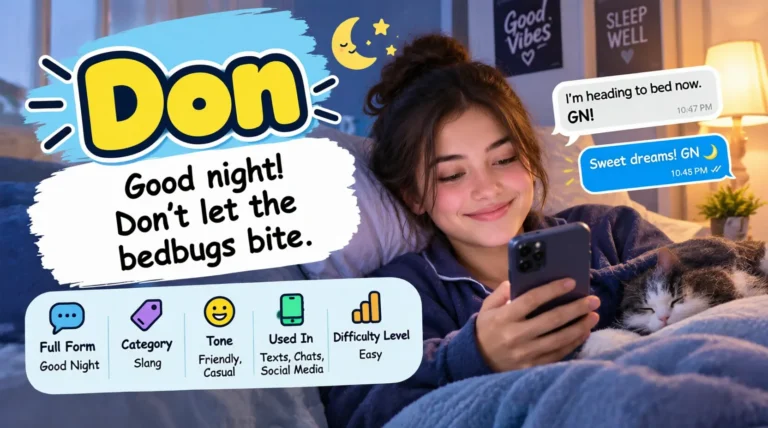
“Don’t let the bedbugs bite” is a playful way to say “good night” or “sleep well.”
People usually say it when someone is going to bed, often as a lighthearted ending to a conversation.
You may see it in texts, social media posts, children’s books, movies, or casual chats.
Understanding the phrase matters because its words sound like a warning, but its usual meaning is actually a friendly bedtime wish.
Quick Answer
| Detail | Answer |
|---|---|
| Meaning | A playful way to say “good night” or “sleep well” |
| Full form | Not an abbreviation; the complete phrase is “Don’t let the bedbugs bite” |
| Pronunciation | dohnt let the BED-bugs bite |
| Category | Idiom / bedtime expression |
| Tone | Playful, friendly, humorous, sometimes affectionate |
| Used on | Texting, social media, casual conversation, children’s speech, entertainment |
| Difficulty level | Easy |
| One-line definition | A humorous good-night expression wishing someone a peaceful night without bedbugs bothering them |
What Does “Don’t Let the Bedbugs Bite” Mean?
The phrase “don’t let the bedbugs bite” is an old-fashioned, playful good-night saying.
When someone says it, they normally aren’t claiming that bedbugs are actually in the room. Instead, they’re using the image of tiny bugs biting someone in bed to add humor to a simple “good night.”
For example:
“Good night! Don’t let the bedbugs bite.”
This simply means:
“Good night. Sleep well.”
The phrase can sound strange if you take it literally. Bedbugs are real insects that can bite people, but in everyday conversation, the expression is usually figurative and playful.
Why Do People Say It?
The phrase gives a little personality to a routine goodbye.
Instead of saying:
“Good night.”
someone might say:
“Sleep tight, and don’t let the bedbugs bite!”
It can make the conversation feel warmer, sillier, or more memorable.
Adults may use it jokingly with friends. Parents may say it to children. Someone may also use it in a text to make a bedtime message sound cute.
The meaning depends heavily on context, but the basic idea remains the same: it is a friendly nighttime farewell.
Where Did the Phrase Come From?
“Don’t let the bedbugs bite” is associated with the traditional bedtime expression “Good night, sleep tight, don’t let the bedbugs bite.”
The exact history of every part of the saying is not completely certain, and several popular explanations have circulated over the years.
One common explanation connects “bedbugs” with the real problem of insects living in beds and bedding. Before modern pest-control methods, bedbugs were a familiar household nuisance. A humorous warning about them could therefore make sense as part of a bedtime saying.
The phrase became established as a piece of English-speaking folk language, especially as a playful line said to children before sleep.
What Does “Sleep Tight” Mean?
“Sleep tight” means sleep well or sleep soundly.
Despite a popular myth, “tight” in this expression is not reliably established as a reference to tightening ropes on an old bed. That explanation is widely repeated, but its historical basis is uncertain.
So it is safer to understand:
“Sleep tight” = “Sleep well.”
And:
“Don’t let the bedbugs bite” = “Have a good night without being bothered by bedbugs.”
Together, they form a humorous bedtime farewell.
Is “Don’t Let the Bedbugs Bite” Literal?
Usually, no.
There are two possible readings:
| Reading | Meaning | Common? |
|---|---|---|
| Figurative | “Good night” or “sleep well” | Very common |
| Literal | A warning about actual bedbugs | Possible, but uncommon |
Context tells you which meaning is intended.
If a parent says it while tucking a child into bed, it’s almost certainly a joke.
If someone is staying in a hotel where bedbugs have actually been found, the same words could be a genuine warning.
Example of the Figurative Meaning
Mia: “I’m exhausted. I’m going to bed.”
Sam: “All right. Good night, and don’t let the bedbugs bite!”
Meaning: Sam is simply wishing Mia a good night’s sleep.
Example of the Literal Meaning
Alex: “Did you check the mattress?”
Jamie: “Yes. The hotel room may have bedbugs.”
Alex: “Then don’t let the bedbugs bite.”
Meaning: Here, the speaker may actually be referring to bedbugs rather than using the traditional joke.
Is It a Slang Term?
Not really.
“Don’t let the bedbugs bite” is better described as a traditional idiomatic expression or bedtime saying than modern slang.
Modern slang often changes quickly and may be strongly tied to a particular online community. This phrase is much older and has been used across generations.
That said, people can use it in a casual or humorous way, especially in text messages and social media.
Is It Rude or Offensive?
Generally, no.
The phrase is normally harmless and playful.
It doesn’t contain an insult or offensive meaning. However, tone and situation always matter.
For example, saying it warmly to a child is friendly:
“Good night, sweetheart. Don’t let the bedbugs bite!”
Saying it sarcastically to someone who is genuinely worried about bedbugs could come across as insensitive.
So the expression itself isn’t rude. The context can change how it feels.
Is It Flirty?
It can be, but the phrase itself isn’t inherently romantic.
A romantic partner might use it as a cute bedtime message:
“Sleep well ❤️ Don’t let the bedbugs bite.”
In that situation, the surrounding relationship makes the message affectionate.
But a friend, parent, teacher, or relative can use the exact same phrase without any romantic meaning.
| Context | Likely feeling |
|---|---|
| Parent → child | Playful |
| Friend → friend | Funny or casual |
| Partner → partner | Cute or affectionate |
| Teacher → young student | Traditional / playful |
| Stranger → stranger | Usually casual, but context matters |
| Person genuinely discussing an infestation | Potentially literal |
How Is It Used in Text Messages?
In texting, the phrase often works as a playful alternative to “good night.”
Example 1: Friendly
You: “I’m heading to bed. Night!”
Friend: “Night! Don’t let the bedbugs bite 😂”
Meaning: Your friend is jokingly wishing you a good night’s sleep.
Example 2: Affectionate
You: “I’m falling asleep.”
Partner: “Then get some rest. Don’t let the bedbugs bite ❤️”
Meaning: The phrase is being used as a cute bedtime message.
Example 3: Funny
You: “Why are you still awake?”
Friend: “Because I’m watching one more episode.”
You: “One more? Sure. Don’t let the bedbugs bite.”
Meaning: You’re joking about the person eventually going to sleep.
Does It Have a Special Meaning on TikTok, Instagram, Snapchat, or WhatsApp?
There is no standard platform-specific meaning for “don’t let the bedbugs bite.”
On TikTok, Instagram, Snapchat, WhatsApp, Facebook, Discord, and similar platforms, the phrase generally keeps its ordinary meaning.
Its presentation may change, though. Someone might use:
- 😂 for humor
- 😴 for sleep
- 🛏️ for bedtime
- ❤️ for affection
- 👀 for teasing
- “lol” to make the joke obvious
For example:
“Okayyy, go to sleep 😂 Don’t let the bedbugs bite.”
The emojis can change the mood, but they don’t create a new standard definition.
How Is It Used in Gaming and Discord?
Gamers may use the expression when someone logs off for the night.
Player 1: “I’m done. It’s 2 a.m.”
Player 2: “Go sleep 😂 Don’t let the bedbugs bite.”
Here, it simply means “Good night.”
It can also be used jokingly after a long gaming session:
“GG. I’m logging off. Don’t let the bedbugs bite.”
Again, there’s no special gaming definition. It’s just being adapted to a gaming conversation.
Can You Say It in Professional Messages?
Usually, it’s better to avoid it in formal or highly professional communication.
For example, this sounds too casual for many workplace situations:
“Thanks for the meeting. Don’t let the bedbugs bite!”
It might be fine between close coworkers who regularly joke with each other, but a more neutral choice would be:
“Have a good evening.”
or:
“Have a good night.”
The phrase is most natural when the relationship is casual, friendly, playful, or familiar.
When Should You Use It?
Use “don’t let the bedbugs bite” when you want your good-night message to sound:
- Playful
- Friendly
- Funny
- Child-friendly
- Lighthearted
- A little old-fashioned
- Affectionate, when the context supports it
It works especially well at the end of a casual conversation.
When Should You Avoid It?
Avoid the phrase when:
- Someone is genuinely dealing with bedbugs.
- The situation is formal.
- The person may not understand the expression.
- You need a clear, serious message.
- The joke could make someone’s concern seem unimportant.
In those situations, plain language is better.
Common Misunderstandings
“Does it mean there are bedbugs?”
Usually, no.
It’s normally just a traditional joke connected to bedtime.
“Is it a threat?”
No.
The phrase isn’t normally threatening. “Bite” refers to the imaginary bedbugs in the saying.
“Is it an insult?”
No.
Calling someone a “bedbug” could have a different meaning in another context, but the standard bedtime phrase isn’t an insult.
“Is it only for children?”
No.
Although children commonly hear it from parents or caregivers, adults use it too, usually for humor or affection.
“Does it mean sleep badly?”
No.
The intended message is the opposite: have a peaceful and comfortable night.
“Don’t Let the Bedbugs Bite” vs. Similar Good-Night Expressions
Several expressions can communicate the same basic idea.
| Expression | Meaning | Tone |
|---|---|---|
| Good night | Goodbye until tomorrow / bedtime wish | Neutral |
| Sleep well | Have a good night’s sleep | Warm |
| Sleep tight | Sleep well | Friendly / traditional |
| Sweet dreams | Have pleasant dreams | Warm / affectionate |
| Night! | Casual good night | Very casual |
| Don’t let the bedbugs bite | Good night, said playfully | Humorous / traditional |
| Rest well | Get good rest | Neutral / caring |
The biggest difference is personality. “Good night” is straightforward, while “don’t let the bedbugs bite” adds a joke.
How to Reply to “Don’t Let the Bedbugs Bite”
You don’t need a special response.
A normal reply is:
“Haha, good night!”
You can also say:
“You too!”
“Sweet dreams!”
“Night! Sleep well.”
“Haha, I’ll try!”
If the person is being affectionate, you can match that tone:
“You too ❤️ Sweet dreams.”
A Funny Reply
If you’re joking with a friend, you could answer:
“I’ll keep an eye out. 😂”
The important thing is to match the tone of the original message.
Natural Conversation Examples
Example 1: Parent and Child
Parent: “Time for bed.”
Child: “Just five more minutes!”
Parent: “Nope. Good night. Don’t let the bedbugs bite.”
Explanation: The parent uses the phrase as a playful way to end the bedtime conversation.
Example 2: Two Friends
Chris: “I’m going offline. I’ve got class tomorrow.”
Taylor: “Fair enough. Don’t let the bedbugs bite!”
Explanation: Taylor is simply saying good night in a humorous way.
Example 3: Romantic
Sam: “I’m going to sleep now.”
Jamie: “Okay. Sleep well. Don’t let the bedbugs bite ❤️”
Explanation: The phrase is affectionate because of the romantic context, not because the expression itself means romance.
Example 4: Online Chat
User 1: “It’s almost 3 a.m. 😭”
User 2: “GO TO BED 😂 Don’t let the bedbugs bite.”
Explanation: The phrase adds humor to a suggestion that the person should finally go to sleep.
Similar Expressions and Their Differences
“Don’t let the bedbugs bite” is sometimes confused with other bedtime sayings.
“Sleep Tight”
Meaning: Sleep well.
Difference: “Sleep tight” is shorter and more direct. It doesn’t include the humorous bedbug image.
“Sweet Dreams”
Meaning: A wish that someone has pleasant dreams.
Difference: This sounds warmer and sometimes more affectionate.
“Good Night”
Meaning: A standard farewell before sleep.
Difference: It’s neutral and works in almost every situation.
“Sweet Dreams, Don’t Let the Bedbugs Bite”
These expressions can be combined:
“Good night! Sweet dreams, and don’t let the bedbugs bite.”
This simply stacks several playful bedtime wishes together.
Is There an Abbreviation?
There isn’t a widely established standard abbreviation for “don’t let the bedbugs bite.”
Unlike common texting abbreviations such as BRB (“be right back”) or LOL (“laughing out loud”), the phrase is normally written out.
You may see people shorten it creatively in casual messages, but such forms aren’t standard and shouldn’t be treated as established slang.
Key Takeaway
“Don’t let the bedbugs bite” is a playful way to say “good night” or “sleep well.” It comes from the traditional bedtime saying associated with “sleep tight” and has been used as a humorous nighttime farewell for generations.
Most of the time, it isn’t literal, rude, offensive, or secretly romantic. The surrounding conversation determines the exact tone.
If someone sends you:
“Good night, don’t let the bedbugs bite!”
the safest interpretation is simply:
“Good night. Sleep well!”
Best search intent covered: meaning → origin → tone → examples → texting/social use → misunderstandings → replies → similar expressions.
Would you like the next version optimized more for **Google featured snippets, PAA FAQs, or a natural blog style**?