
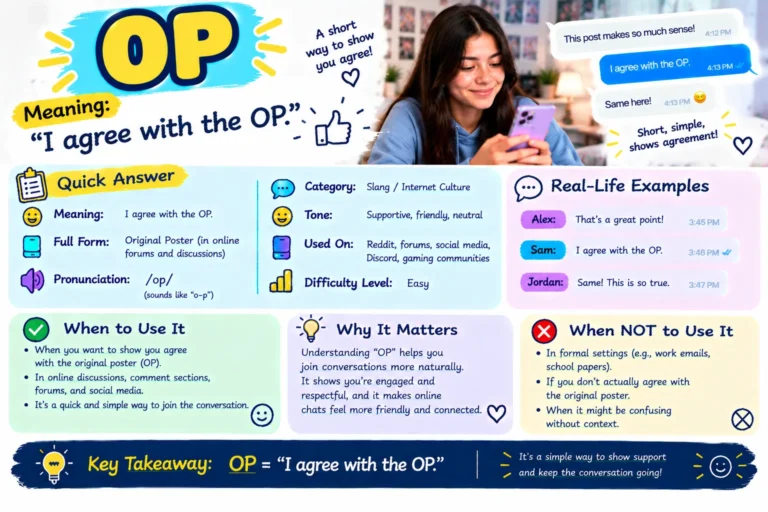
If you see “OP” in a text, comment, Reddit post, or online conversation, it usually means “Original Poster”—the person who first created or shared a post.
In gaming, however, OP can mean “overpowered,” describing a character, weapon, or ability that seems too strong. The meaning depends on the context.
People often search for “OP meaning in text” because the abbreviation appears across social media, forums, group chats, and gaming communities.
Knowing which meaning someone intends can help you understand the conversation and avoid an awkward reply.
Quick Answer
| Detail | Answer |
|---|---|
| Meaning | Usually “Original Poster” |
| Full Form | Original Poster |
| Pronunciation | Usually said as the letters “O-P” |
| Category | Internet slang / online abbreviation |
| Tone | Neutral; can be casual |
| Used On | Reddit, forums, Discord, social media, chats, gaming |
| Difficulty Level | Easy |
| One-line definition | OP usually refers to the person who originally made an online post. |
In gaming: OP commonly means “overpowered,” meaning something is unusually strong or difficult to beat.
What Does OP Mean in Text?
In most online conversations, OP means “Original Poster.”
An original poster is the person who created the post being discussed. The term is especially common on forums and discussion sites where many people reply to one person’s original message.
For example:
“I agree with the OP.”
This means:
“I agree with the person who made the original post.”
You may also see “the OP,” “OP,” or “original poster” used to identify that person.
Why Is “OP” Used Instead of “Original Poster”?
It saves time and makes online conversations easier to follow.
Imagine a post has 200 comments. Instead of repeatedly writing “the person who made the original post,” users can simply say OP.
The abbreviation is also useful when several people are commenting on the same discussion.
OP Meaning on Reddit
On Reddit, OP almost always refers to the Original Poster when people are talking about a discussion or question.
For example:
“OP mentioned that they tried this already.”
This means the person who created the Reddit post said they had already tried it.
Another example:
“Thanks for the update, OP!”
Here, the commenter is speaking directly to the person who created the original post.
The meaning can usually be understood from the conversation itself. If people are discussing a person’s post, Original Poster is the likely meaning.
OP Meaning on Social Media
The same meaning can appear on social media platforms such as Instagram, Facebook, TikTok, and other discussion-based communities.
For example:
“The OP explained the whole story in the caption.”
Here, OP means the person who originally shared the content.
However, social media users don’t always use the abbreviation consistently. Some may use OP to mean the creator of a post, video, image, or discussion rather than strictly the person who wrote a text post.
So the broader idea is:
OP = the person who originally posted the content being discussed.
OP Meaning on Discord
On Discord, OP can mean “Original Poster” when users are discussing a message or conversation that started in a channel.
For example:
“Ask OP what server they’re using.”
This means:
“Ask the person who originally posted the message.”
Discord has many gaming communities, though, so OP can also mean “overpowered.” Context matters.
OP Meaning in Gaming
Gaming is where OP has a very different and extremely common meaning.
In gaming, OP usually means “overpowered.”
Players use it when a character, weapon, skill, item, strategy, or mechanic is considered much stronger than it should be.
For example:
“That weapon is OP.”
This means:
“That weapon is overpowered.”
A player might say this because the weapon does very high damage, has few weaknesses, or is much stronger than other available choices.
Gaming Examples
“That character is so OP.”
The player thinks the character is unusually powerful.
“They need to nerf that gun. It’s OP.”
The player thinks the gun is too strong and should probably be weakened.
“This build is OP after the update.”
The player thinks the build has become extremely powerful after a game update.
In gaming, OP does not normally mean Original Poster when it appears directly next to words such as “weapon,” “character,” “build,” or “ability.”
Original Poster vs. Overpowered
The easiest way to understand the two major meanings is to look at what comes after OP.
| Context | OP Usually Means | Example |
|---|---|---|
| Reddit discussion | Original Poster | “OP answered my question.” |
| Forum thread | Original Poster | “The OP added more details.” |
| Social media discussion | Original Poster | “OP posted an update.” |
| Gaming | Overpowered | “That weapon is OP.” |
| Character discussion | Overpowered | “This hero is OP.” |
| Weapon discussion | Overpowered | “That gun is OP.” |
| Strategy/build discussion | Overpowered | “That build is OP.” |
A Simple Rule
Ask yourself:
Are people talking about a person who made a post?
If yes, OP probably means Original Poster.
Are they talking about something that is unusually strong in a game?
If yes, OP probably means Overpowered.
Natural Text Examples
Here are some common ways you might see OP used online.
Example 1: Discussion
Person A: “Does anyone know how to fix this problem?”
Person B: “OP said they already restarted the app.”
Meaning: Person B is referring to the person who created the original post.
Example 2: Comment Section
Person A: “OP, where did you buy this?”
Meaning: The person is asking the original poster where they got something.
Example 3: Gaming
Person A: “What do you think of the new character?”
Person B: “Honestly, it’s OP.”
Meaning: The character is considered overpowered.
Example 4: Gaming Advice
Person A: “Why does everyone use this weapon?”
Person B: “Because it’s completely OP right now.”
Meaning: The weapon is considered much stronger than other options.
Is OP Rude?
No. “OP” is not inherently rude or offensive.
When it means “Original Poster,” it’s simply a convenient way to refer to the person who created a post.
When it means “overpowered,” it’s usually an opinion about something in a game.
The tone depends on the surrounding message. A sentence like:
“OP, thanks for sharing this.”
is friendly.
A sentence like:
“OP clearly doesn’t know what they’re talking about.”
could sound insulting, but the insult comes from the rest of the sentence—not from the abbreviation OP itself.
Is OP Flirty?
No. OP is not normally a flirty abbreviation.
If someone writes:
“OP, you’re hilarious.”
they’re probably addressing the person who created the post.
Any romantic or flirty meaning would have to come from the surrounding conversation rather than from OP itself.
Is OP Offensive?
Generally, no.
“Original Poster” and “overpowered” are ordinary internet and gaming terms.
Still, online slang can vary between communities. If you’re unsure what someone means, look at the words around OP rather than assuming it has one fixed definition.
Common Mistakes With OP
Mistake 1: Assuming OP Always Means Original Poster
This is one of the most common misunderstandings.
If someone says:
“That boss is OP.”
they’re almost certainly talking about the boss being overpowered, not about a person who created a post.
Mistake 2: Assuming OP Always Means Overpowered
The opposite mistake happens in forums and discussion threads.
If someone says:
“OP added an update.”
they’re most likely referring to the Original Poster.
Mistake 3: Confusing OP With “Opening”
In some contexts, people may use OP for other phrases, including “opening” in certain discussions. However, this isn’t the standard meaning of OP in ordinary texting.
Don’t choose an uncommon meaning unless the context clearly supports it.
Other Meanings of OP
“OP” can have meanings outside internet slang.
Depending on the subject, it can be used as an abbreviation for terms such as:
- Original Poster — online discussions
- Overpowered — gaming
- Operation — some professional, technical, or military contexts
- Opening — certain specialized contexts
- Original — occasionally used informally in discussions about versions or creators
These meanings aren’t equally common.
For everyday internet conversations, Original Poster and Overpowered are the two meanings worth knowing first.
OP vs. OC: What’s the Difference?
OP and OC are sometimes confused because both appear frequently online.
| Abbreviation | Common Meaning | What It Refers To |
|---|---|---|
| OP | Original Poster | The person who made the post |
| OC | Original Content | Content created by the person posting it |
| OP | Overpowered | Something unusually strong in gaming |
For example:
“OP made this post.”
Here, OP means Original Poster.
“This is OC.”
Here, OC usually means the content is Original Content.
A person can be the OP without the content being OC. They may have shared something created by someone else.
How to Reply When Someone Says “OP”
If someone addresses you as OP, they’re usually referring to you as the person who made the original post.
You can simply answer their question.
For example:
Someone: “OP, what camera did you use?”
You: “I used my phone camera.”
You don’t need to respond with “What does OP mean?” if you understand that they’re referring to your post.
If you’re unsure whether they mean “Original Poster” or something else, it’s perfectly reasonable to ask:
“Do you mean the original poster?”
When Should You Use OP?
Use OP when the people in the conversation are likely to understand online abbreviations.
It’s especially natural in:
- Reddit discussions
- Online forums
- Discord communities
- Gaming chats
- Comment sections
- Informal group chats
For formal writing, it’s usually better to write “original poster” unless the abbreviation has already been introduced or is standard for your audience.
When Should You Avoid OP?
Avoid unexplained slang when writing for people who may not know internet abbreviations.
For example, instead of:
“OP should contact support.”
a formal message could say:
“The person who created the post should contact support.”
This is clearer for a general audience.
In professional communication, plain language is often better than internet shorthand.
FAQs
What does OP mean in a text message?
In a text or online message, OP most commonly means “Original Poster” when the conversation is about an online post. In gaming, it often means “overpowered.”
What does OP stand for?
The most common online meaning is Original Poster. In gaming, OP commonly stands for Overpowered.
What does OP mean on Reddit?
On Reddit, OP usually means Original Poster, the person who created the Reddit post being discussed.
What does OP mean in gaming?
In gaming, OP usually means overpowered. It describes something that is considered unusually strong, such as a character, weapon, ability, or build.
What does “OP” mean in comments?
In comments, OP generally means the person who created the original post. For example, “OP replied” means the original poster replied.
What does “OP” mean on Discord?
On Discord, OP can mean Original Poster, especially when discussing a message or thread. In gaming channels, it can also mean overpowered.
Does OP mean original poster or overpowered?
Both are common. The context tells you which one is intended. If OP refers to a person who made a post, it means Original Poster. If it describes a game character, weapon, or ability, it usually means Overpowered.
Is OP a bad word?
No. OP isn’t generally offensive. It’s a common internet abbreviation with neutral meanings.
Is OP slang?
Yes. OP is commonly used as internet slang or an online abbreviation, especially on forums, social media, chat platforms, and gaming communities.
Final Takeaway
OP most commonly means “Original Poster” when you’re discussing an online post. It refers to the person who originally created or shared the post.
In gaming, however, OP usually means “overpowered,” describing something that is considered unusually strong.
The quickest way to tell the difference is to look at the subject:
Person who made a post → Original Poster
Very strong game character, weapon, or ability → Overpowered
Once you look at the surrounding words, the intended meaning is usually easy to spot.
Would you like the next version optimized for a dictionary-style page, a Google featured snippet, or a longer 2,000-word article?