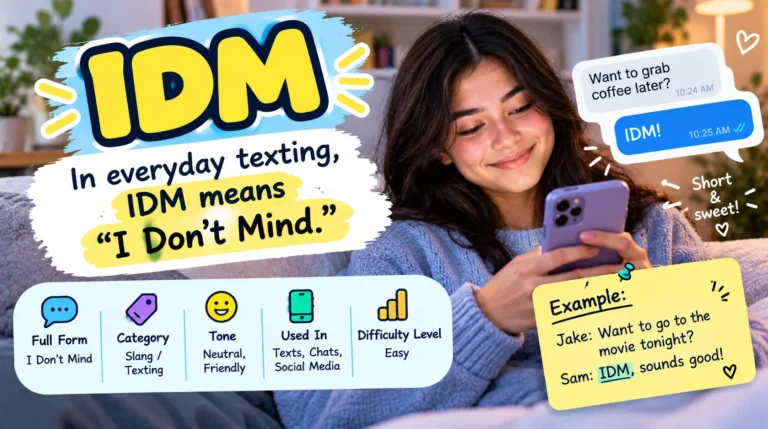
If you see “IDM” in a text, chat, or social media message, it most commonly means “I Don’t Mind.”
People use it to show that they’re okay with something or have no strong pre+erence.
Understanding the context matters because IDM can have other meanings, especially outside casual messaging.
Quick Answer
| Detail | Answer |
|---|---|
| Meaning | I Don’t Mind |
| Full form | I Don’t Mind |
| Pronunciation | Say the letters: “I-D-M” |
| Category | Texting abbreviation / internet slang |
| Tone | Casual, neutral, sometimes agreeable |
| Used on | Text messages, WhatsApp, Instagram, Snapchat, Discord, social media |
| Difficulty level | Easy |
| One-line definition | IDM means “I Don’t Mind” and shows that you’re okay with something or have no preference. |
What Does IDM Mean in Text?
In everyday texting, IDM means “I Don’t Mind.”
It usually tells someone:
- “That’s okay with me.”
- “I’m fine with either choice.”
- “I have no problem with that.”
- “You can choose.”
- “It doesn’t bother me.”
For example:
“Do you want pizza or burgers?”
“IDM.”
Here, the person is saying they don’t have a preference. Either option works for them.
Another example:
“Is it okay if I call you later?”
“IDM.”
In this case, IDM means the person doesn’t mind the call happening later.
Why Do People Use IDM?
The main reason is simple: it saves time.
Typing “I don’t mind” takes longer than typing three letters. In fast conversations, people often use abbreviations such as IDM, IDK, IMO, TBH, BRB, and FYI.
IDM can also make a reply feel relaxed and informal.
For example:
Person 1: “Should we meet at 6 or 7?”
Person 2: “IDM, whichever works for you.”
The second person isn’t refusing. They’re giving the other person freedom to choose.
IDM Examples in Real Conversations
Example 1: Choosing a place
Alex: “Want to eat at the mall?”
Sam: “IDM.”
Meaning: Sam is okay with eating at the mall.
Example 2: Choosing a time
Alex: “Can we start at 8 instead?”
Sam: “IDM.”
Meaning: Sam doesn’t have a problem with starting at 8.
Example 3: Making plans
Alex: “Movie or game night?”
Sam: “IDM, you pick.”
Meaning: Sam has no strong preference and wants Alex to decide.
Example 4: Asking for permission
Alex: “Do you mind if I sit here?”
Sam: “IDM.”
Meaning: Sam is saying that they don’t mind.
Example 5: A potentially different tone
Alex: “Do you want to come with us?”
Sam: “IDM.”
This one is more dependent on context. It could mean “I don’t mind”, but it may also sound vague or uninterested. A clearer reply would be:
“Yeah, sure. I don’t mind.”
This shows why short abbreviations can sometimes create confusion.
What Does IDM Mean on WhatsApp, Instagram, Snapchat, and Discord?
The basic meaning usually stays the same across casual messaging platforms.
| Platform | Common meaning of IDM |
|---|---|
| I Don’t Mind | |
| I Don’t Mind | |
| Snapchat | I Don’t Mind |
| Discord | I Don’t Mind |
| Facebook Messenger | I Don’t Mind |
| Text messages | I Don’t Mind |
| Gaming chats | Usually “I Don’t Mind,” depending on context |
The important thing is the surrounding message, not the platform itself.
For example:
“Which map should we play?”
“IDM.”
In a gaming chat, this most likely means “I don’t mind which map we play.”
Is IDM Rude?
Usually, no.
IDM is normally neutral and casual. However, a one-word abbreviation can sometimes sound dry, dismissive, or uninterested, especially when someone expects a more detailed answer.
Compare:
“IDM.”
with:
“I don’t mind! You can choose 😊”
The second response sounds warmer.
So, IDM itself isn’t rude. The tone comes from the situation, punctuation, and the rest of the conversation.
Is IDM Flirty?
Not by itself.
IDM doesn’t normally have a romantic or sexual meaning in texting. It’s simply a way of saying “I don’t mind.”
However, almost any neutral phrase can take on a flirty tone depending on the conversation.
For example:
“Can I sit next to you?”
“IDM 😉”
The wink changes the tone. The abbreviation itself isn’t what makes the message flirty.
Is IDM Offensive?
No. “I Don’t Mind” isn’t inherently offensive, insulting, or inappropriate.
The only possible issue is that someone might interpret a very short “IDM” as cold or careless if they were looking for enthusiasm.
IDM vs. Similar Texting Abbreviations
Some abbreviations can look similar or appear in the same conversations, but their meanings are different.
| Abbreviation | Meaning | Typical use |
|---|---|---|
| IDM | I Don’t Mind | Showing no objection or preference |
| IDK | I Don’t Know | Showing uncertainty |
| IDC | I Don’t Care | Showing that something doesn’t matter to you |
| IMO | In My Opinion | Giving an opinion |
| TBH | To Be Honest | Introducing an honest opinion |
| NVM | Never Mind | Dropping or dismissing a topic |
| IK | I Know | Showing that you already know something |
IDM vs. IDC
This is one of the most important distinctions.
IDM = I Don’t Mind
IDC = I Don’t Care
They can look similar, but their tone can be very different.
“Which restaurant should we go to?”
“IDM.”
This normally means:
“Either restaurant is fine with me.”
But:
“Which restaurant should we go to?”
“IDC.”
can sound more like:
“I don’t care. You decide.”
So IDM is generally softer and more agreeable than IDC.
IDM vs. IDK
These are also easy to confuse.
“Do you want coffee or tea?”
“IDM.”
This means the person is fine with either choice.
But:
“Do you know where the café is?”
“IDK.”
This means “I don’t know.”
IDM expresses a lack of preference. IDK expresses a lack of knowledge.
Other Meanings of IDM
Although “I Don’t Mind” is the common meaning in casual texting, IDM can stand for other things in different fields.
For example, IDM can appear as an abbreviation in technology, business, education, music, and other specialized contexts.
That doesn’t mean those meanings should automatically be applied to a text message.
If someone sends:
“IDM, you choose.”
the casual texting meaning is clearly “I Don’t Mind.”
The context should always come first.
When Should You Use IDM?
IDM works well when you’re having a casual conversation and want to say that you have no objection.
You can use it when:
- Someone asks you to choose between two options.
- Someone asks whether something bothers you.
- You’re okay with another person’s suggestion.
- You don’t have a strong preference.
- You’re chatting casually with friends.
For example:
“Want to watch a comedy or action movie?”
“IDM, you choose.”
That’s a natural use.
When Should You Avoid IDM?
Avoid IDM when the conversation is formal or important.
For example, in a professional email, writing:
“IDM.”
can seem too informal or unclear.
Instead, write:
“Either option works for me.”
or:
“I don’t have a preference.”
The same applies when you’re discussing an important decision. A clear sentence is often better than an abbreviation.
How Do You Reply to IDM?
The best response depends on what you asked.
If you’re choosing between two options, you can simply make the choice:
“IDM.”
“Okay, let’s go with pizza.”
If you want to check whether the person really agrees:
“Are you sure? I’m good with either one too.”
If you want to keep the conversation moving:
“Cool, let’s meet at 7 then.”
There’s no special response required just because someone used IDM.
Common Misunderstandings About IDM
“IDM” doesn’t always mean “I don’t care”
This is the biggest mistake.
I Don’t Mind usually means the person is okay with something.
I Don’t Care can suggest that the person has little interest or concern.
The two ideas overlap, but the emotional tone isn’t always the same.
IDM doesn’t automatically mean agreement
If someone says:
“IDM.”
they’re usually saying that something isn’t a problem for them.
That doesn’t necessarily mean they’re excited about it.
For example:
“Want to go hiking tomorrow?”
“IDM.”
This may mean “I’m okay with it,” not necessarily “I’m really looking forward to it.”
Frequently Asked Questions
What does IDM stand for in texting?
In texting, IDM most commonly stands for “I Don’t Mind.” It’s used to show that you’re okay with something or don’t have a strong preference.
What does IDM mean on social media?
On social media and in casual chats, IDM usually means “I Don’t Mind.” The exact interpretation can depend on the surrounding conversation.
Does IDM mean “I don’t care”?
Not exactly. IDM means “I Don’t Mind,” while IDC means “I Don’t Care.” IDM is generally a softer way to say you’re okay with something.
Is IDM a slang word?
It’s better described as a texting abbreviation or internet shorthand rather than traditional slang.
Is IDM rude?
Usually not. But a very short reply such as “IDM” can sometimes feel dry or uninterested depending on the conversation.
Is IDM flirty?
No. IDM has no inherently flirty meaning. A flirty tone can come from the surrounding conversation, emojis, or context.
What does IDM mean in a relationship text?
It usually still means “I Don’t Mind.” For example, if someone asks, “Can I call you later?” and you answer “IDM,” you’re saying that calling later is fine with you.
What does IDM mean in gaming?
In gaming chat, IDM generally means “I Don’t Mind.” For example, if teammates ask which map to play and someone replies “IDM,” they’re saying they have no preference.
Final Takeaway
IDM most commonly means “I Don’t Mind” in text messages and online chats.
It’s used when someone is okay with a choice, suggestion, request, or situation and doesn’t have a strong preference.
The key distinction to remember is IDM vs. IDC: “I don’t mind” is generally more neutral and agreeable, while “I don’t care” can sound much more dismissive.
When you’re chatting casually, IDM is perfectly fine. For professional or important conversations, though, spelling out what you mean is usually clearer.