
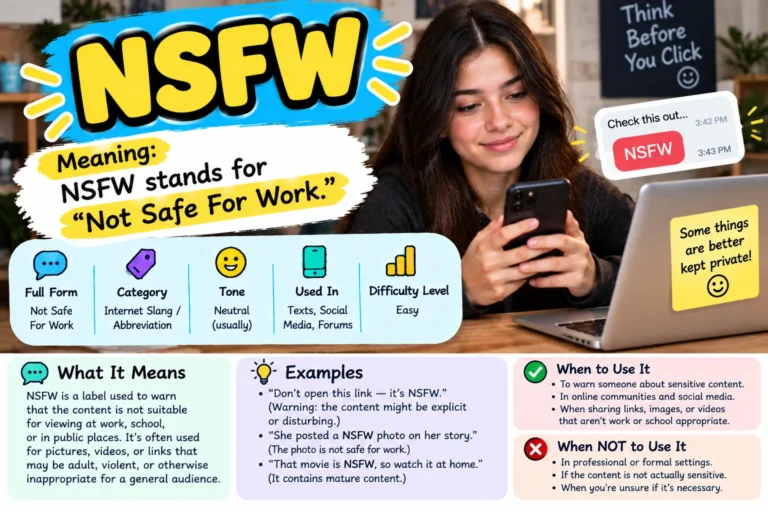
If someone sends you “NSFW” in a text, chat, post, or message, it usually means “Not Safe For Work.”
It warns that the content may be sexual, graphic, offensive, or otherwise unsuitable to view in a public or professional setting.
You may see NSFW on social media, Discord, Reddit, messaging apps, gaming communities, and websites.
Quick Answer
| Detail | Answer |
|---|---|
| Meaning | Not Safe For Work |
| Full form | Not Safe For Work |
| Pronunciation | “N-S-F-W” |
| Category | Internet abbreviation / content warning |
| Tone | Usually neutral and cautionary |
| Used on | Texts, social media, forums, chats, gaming, websites |
| Difficulty level | Easy |
| One-line definition | A warning that content may be inappropriate or risky to view at work, school, or in public. |
What Does NSFW Mean in Text?
NSFW stands for “Not Safe For Work.”
When someone labels a message, image, video, link, or post as NSFW, they’re telling you to be careful before opening or viewing it.
The warning doesn’t always mean the content is explicitly sexual. It can also refer to:
- Nudity or sexual material
- Graphic violence
- Gore or disturbing images
- Strong or offensive language
- Shocking content
- Other material that could cause trouble in a workplace, classroom, or public setting
The exact meaning depends on the context.
For example:
“I found a funny NSFW meme.”
This means the meme may contain material that isn’t appropriate to open around coworkers, teachers, children, or other people nearby.
Is NSFW Always Sexual?
No. Sexual content is one of the most common reasons something gets labeled NSFW, but the abbreviation has a broader meaning.
A violent image, graphic accident video, or extremely offensive picture may also receive an NSFW warning.
So it’s better to think of NSFW as a content warning, not simply a word for sexual content.
Why Do People Use NSFW?
People use NSFW as a quick warning.
Online content can appear unexpectedly, and a short label gives the reader a chance to decide whether it’s a good time to open it.
For example:
“NSFW: Don’t open this at the office.”
The sender isn’t necessarily saying the content is bad. They’re warning you that viewing it in a professional or public environment could be awkward or inappropriate.
NSFW can also save someone from accidentally displaying sensitive content on a shared screen or during a meeting.
Where Is NSFW Commonly Used?
NSFW is an internet term, so you’ll see it across many types of online communication.
Text Messages
Someone might send:
“I have a weird video for you. NSFW though.”
Here, the person is warning you that the video may not be suitable for viewing around other people.
Social Media
Posts, profiles, images, and videos may be marked NSFW when they contain mature or sensitive material.
The exact rules differ between platforms, but the basic idea is the same: be careful before viewing.
Discord
In a Discord conversation, someone may write:
“NSFW warning before you click.”
This tells other members that the linked material may contain adult or otherwise unsuitable content.
Gaming Communities
Gamers may use NSFW when sharing screenshots, artwork, jokes, clips, or links containing mature material.
The term isn’t limited to gameplay itself.
Forums and Online Communities
Community members often put “NSFW” in a post title so readers know what they’re about to encounter.
For example:
“NSFW — graphic image”
This is a stronger warning because it tells readers that the material may be disturbing, not merely inappropriate for an office.
Dating Apps
NSFW can appear when people discuss mature photos, sexual topics, or adult content.
In this setting, context matters a lot. Someone saying “NSFW” doesn’t automatically mean they’re flirting with you. It may simply be a warning.
Natural Text Examples
Here are some common ways people use NSFW in everyday messages.
Example 1
Alex: “Check out this link 😂”
Sam: “Is it safe to open here?”
Alex: “Probably not. NSFW.”
Meaning: Alex is warning Sam not to open the link in a public or professional setting.
Example 2
Mia: “I sent you the picture.”
Jordan: “NSFW?”
Mia: “Yeah, don’t open it around your parents.”
Meaning: Jordan is asking whether the picture contains mature or inappropriate material.
Example 3
Chris: “This video is hilarious but NSFW.”
Taylor: “I’ll watch it later.”
Meaning: Taylor understands that the video may not be appropriate to watch at work, school, or around other people.
Example 4
Sam: “Why did you mark the post NSFW?”
Alex: “It has graphic images.”
Meaning: NSFW can describe disturbing or graphic content, not only sexual material.
What Does NSFW Mean on Social Media?
On social media, NSFW usually acts as a warning about mature or sensitive content.
It can appear:
- In a caption
- Before a link
- In a post title
- As a hashtag
- In a profile or community description
- As part of a content label
The label gives viewers information before they decide whether to continue.
However, NSFW isn’t a universal legal or technical rating system. One person may use it for mild mature humor, while another may use it only for explicit or graphic material.
Is NSFW Rude?
The abbreviation itself isn’t rude.
NSFW is normally a neutral warning.
For example:
“NSFW link—open later.”
That’s simply a caution.
The content behind the warning may be offensive, sexual, violent, or disturbing, but the term NSFW itself isn’t an insult or profanity.
Is NSFW Flirty?
Not necessarily.
This is an important distinction.
If someone texts:
“I have an NSFW picture for you.”
The message may involve sexual or adult content, but the word NSFW alone doesn’t establish romantic or sexual intent.
Context matters. The relationship between the people, the content being discussed, and the rest of the conversation can change the meaning.
So don’t automatically interpret NSFW = flirting.
Is NSFW Offensive?
NSFW is not inherently offensive. It’s a warning label.
However, the content described as NSFW might be offensive or upsetting.
For example:
- A sexual image may be NSFW.
- A graphic injury may be NSFW.
- A hateful or extremely offensive image may be NSFW.
- A shocking video may be NSFW.
The abbreviation tells you to expect potentially unsuitable material; it doesn’t tell you exactly what the material contains.
NSFW vs. SFW
You may also see SFW, which means “Safe For Work.”
| Term | Full Form | Meaning |
|---|---|---|
| NSFW | Not Safe For Work | May be inappropriate or unsuitable to view publicly |
| SFW | Safe For Work | Generally considered suitable for a workplace or public setting |
For example:
“This version is SFW.”
means the person believes the content is suitable for normal viewing.
Meanwhile:
“The original version is NSFW.”
means the original may contain mature, graphic, or otherwise unsuitable material.
NSFW vs. Adult Content
These terms overlap, but they’re not identical.
Adult content usually refers specifically to material intended for adults, often involving sexual themes.
NSFW is broader. It can warn about sexual material, but it can also warn about violence, gore, profanity, or other content that could be inappropriate in certain environments.
So:
All adult content may be NSFW, but not everything labeled NSFW is adult content.
NSFW vs. Explicit
Explicit usually means the content clearly or strongly presents sexual, violent, or other mature material.
NSFW focuses more on where or when you should view it.
For example:
“This song has explicit lyrics.”
describes the content.
“This link is NSFW.”
warns you about viewing the material in a workplace or public environment.
A piece of content can therefore be both explicit and NSFW.
Common Mistakes People Make With NSFW
Mistake 1: Thinking It Only Means Porn
NSFW often refers to sexual content, but that’s not its only use.
Graphic violence and disturbing imagery can also be labeled NSFW.
Mistake 2: Assuming NSFW Means Illegal
It doesn’t.
NSFW simply describes content that may be inappropriate or unsuitable in a particular environment.
The label itself says nothing about whether the content is legal.
Mistake 3: Thinking NSFW Is an Exact Rating
It’s not a precise rating like a formal age classification.
Different people and communities may use the term differently.
Mistake 4: Ignoring the Warning
If someone marks something NSFW, it’s smart to consider your surroundings before opening it.
You might be at:
- Work
- School
- A library
- A family gathering
- A public place
- A shared computer
Mistake 5: Assuming the Sender Is Flirting
A person may use NSFW simply because they’re warning you about the material.
Look at the full conversation instead of interpreting the abbreviation by itself.
How Should You Reply to an NSFW Message?
Your response depends on what you want to do.
If you’re okay with viewing it:
“Got it. I’ll check it later.”
If you’re in public:
“Thanks for the warning. I’ll open it when I’m somewhere private.”
If you don’t want to see it:
“No thanks, I’ll pass.”
If you want to know what it contains:
“What kind of NSFW content is it?”
If you’re unsure about someone’s intentions:
“What do you mean by NSFW?”
These responses let you set a clear boundary without making the conversation awkward.
When Should You Use NSFW?
Use NSFW when you’re sharing material that someone may not want to display in a public, professional, or shared environment.
A useful warning might look like:
“NSFW — graphic image.”
or:
“NSFW warning before opening.”
A more specific warning is often even better.
Instead of only saying:
“NSFW”
you could say:
“NSFW — sexual content.”
or:
“NSFW — graphic violence.”
That gives the reader more information and helps them make an informed choice.
When Should You Not Use NSFW?
Don’t use NSFW as a joke if doing so could hide an important warning.
Also, don’t assume that adding “NSFW” makes inappropriate material acceptable everywhere.
A workplace, school, community, or platform may have its own rules about mature or graphic content.
The warning is useful, but it doesn’t replace good judgment or community guidelines.
What Does NSFW Mean From a Friend?
If a friend sends you:
“NSFW 😂”
they’re probably warning you that whatever they’re about to send may be inappropriate to open around other people.
The emoji may make the message sound playful, but the basic meaning remains a warning.
You still need to look at the surrounding conversation to understand why they used it.
What Does NSFW Mean From a Stranger?
If a stranger sends an NSFW link or image, be more cautious.
You don’t know what’s behind the link, and the label doesn’t guarantee that the content is safe.
If you don’t recognize the sender or trust the source, you don’t have to open it.
You can simply ignore, block, or report the message when appropriate.
Safety Tips for NSFW Links and Messages
An NSFW label tells you something about the type of content, but it doesn’t prove that a link is trustworthy.
Keep these points in mind:
- Don’t open unexpected links from strangers.
- Be careful with downloads.
- Don’t share private images without permission.
- Remember that screenshots can be saved and shared.
- Follow workplace, school, and community rules.
- If you’re underage, avoid adult material and don’t share intimate images.
- If someone pressures you to view or send sexual material, you can refuse.
Most importantly, NSFW is a warning, not a guarantee of safety.
Frequently Asked Questions
What does NSFW mean in texting?
NSFW means “Not Safe For Work.” In texting, it’s usually a warning that a message, image, video, or link may contain sexual, graphic, offensive, or otherwise unsuitable content.
What does NSFW stand for?
NSFW stands for Not Safe For Work.
Does NSFW mean inappropriate?
Usually, yes, in the sense that the content may not be suitable for viewing in a workplace, school, or public setting. It doesn’t necessarily mean the content is illegal or inherently wrong.
Does NSFW always mean sexual?
No. Sexual content is a common use, but NSFW can also refer to graphic violence, gore, disturbing images, strong language, or other mature material.
What does SFW mean?
SFW means “Safe For Work.” It’s commonly used for content that is considered suitable for viewing in a workplace or other public setting.
Is NSFW a bad word?
No. NSFW is an abbreviation and content warning. It isn’t profanity.
Does NSFW mean 18+?
Not automatically. NSFW often suggests mature content, but it isn’t a formal age rating. The actual content and the rules of the platform or community determine whether it is appropriate for adults only.
Can NSFW mean violence?
Yes. Graphic violence, gore, or disturbing imagery may be labeled NSFW.
What should I do if someone sends me an NSFW message?
If you’re comfortable with it, you can view it in a private and appropriate setting. If you’re unsure, ask what it contains. If you don’t want to see it, you can simply decline.
Is NSFW the same as porn?
No. Pornographic material is commonly NSFW, but NSFW has a wider meaning and can include many kinds of mature or disturbing content.
What does an NSFW warning mean on a website?
It generally tells you that the page or material may contain content that isn’t suitable for work, school, public viewing, or other shared environments.
Key Takeaway
NSFW means “Not Safe For Work.” In text messages and online conversations, it’s mainly used as a warning that something may contain sexual, graphic, offensive, or otherwise mature material.
The most important thing to remember is that NSFW doesn’t always mean sexual, and it doesn’t automatically mean the sender is flirting. It’s simply a signal to think before opening or viewing the content.
When you see NSFW, check your surroundings, consider the source, and decide whether you’re comfortable viewing it.
Would you like the next version optimized more for Google featured snippets, semantic SEO, or maximum readability?