
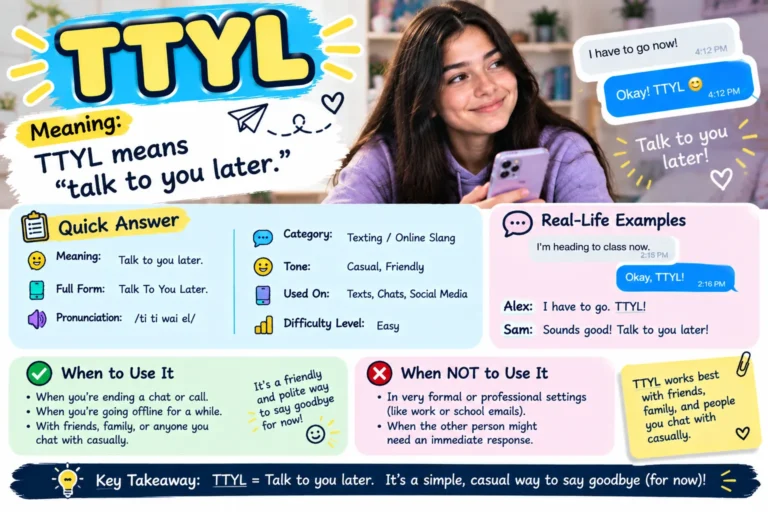
If you’ve seen “TTYL” in a text, chat, comment, or social media message, it usually means “talk to you later.”
It’s a casual way to end a conversation without sounding too formal. You’ll often see TTYL in texting, Snapchat, Instagram, WhatsApp, Discord, gaming chats, and other online conversations.
Knowing what it means helps you understand whether someone is simply leaving the chat, ending the conversation for now, or using a friendly bit of internet slang.
Quick Answer
| Detail | Answer |
|---|---|
| Meaning | Talk to you later |
| Full form | Talk To You Later |
| Pronunciation | “tee-tee-why-el” |
| Category | Texting abbreviation / internet slang |
| Tone | Casual, friendly, informal |
| Used on | Text messages, social media, chats, gaming, DMs |
| Difficulty level | Very easy |
| One-line definition | TTYL means you’ll talk to someone again later. |
What Does TTYL Mean in Text?
TTYL means “talk to you later.”
People use it when they’re ending a conversation but expect to communicate with the other person again.
For example:
“I have to go finish my homework. TTYL!”
This means:
“I have to go finish my homework. I’ll talk to you later!”
TTYL doesn’t usually mean that the person is upset or trying to avoid you. In most cases, it’s simply a quick and casual goodbye.
Why Do People Use TTYL?
The main reason is convenience. Typing four letters is much faster than typing “talk to you later.”
But TTYL can also make a message feel relaxed and friendly.
People may use it when:
- They have to leave a chat
- They’re going offline
- They need to do something else
- The conversation is naturally ending
- They plan to talk again later
- They want a casual alternative to “goodbye”
It’s especially common in fast-moving conversations where people use abbreviations such as BRB, LOL, IDK, and BTW.
Is TTYL Rude?
Usually, no.
TTYL is generally a friendly or neutral way to end an informal conversation.
However, tone depends on the situation. For example:
Friendly:
“I’m heading out now. TTYL 😊”
This sounds warm and casual.
Neutral:
“I need to study. TTYL.”
This simply ends the conversation.
Potentially cold:
“TTYL.”
If someone sends only “TTYL” after a serious or emotional conversation, it might feel abrupt. The abbreviation itself isn’t rude, but the surrounding context can change how it feels.
Is TTYL Flirty?
TTYL is not inherently flirty.
It simply means “talk to you later.”
Someone you’re dating or interested in may use it, but that doesn’t make the abbreviation romantic.
For example:
“Goodnight! TTYL ❤️”
The heart emoji and the rest of the message may make the conversation feel affectionate. TTYL itself doesn’t carry that meaning.
Likewise:
“Got class now, TTYL!”
is simply casual.
So if you’re wondering, “Does TTYL mean they like me?”, the answer is: not by itself. Look at the person’s overall behavior and the context of the conversation.
TTYL on Different Platforms
The meaning of TTYL stays basically the same across messaging and social platforms. The style of the conversation can change, though.
TTYL on TikTok
On TikTok, TTYL may appear in comments, direct messages, captions, or conversations between users.
Example:
“I gotta go 😭 ttyl”
Here, the person is saying they have to leave and will talk again later.
TTYL on Snapchat
Snapchat conversations are often quick and informal, so TTYL fits naturally.
Example:
“My phone is dying lol, ttyl.”
It means the person is ending the chat for now.
TTYL on Instagram
You may see TTYL in DMs or comments, especially when friends are chatting casually.
Example:
“I’m going to dinner. TTYL!”
TTYL on WhatsApp
TTYL can be used in both one-on-one chats and group conversations.
Example:
“I have to run an errand. TTYL.”
The meaning remains “talk to you later.”
TTYL on Discord
Discord users often use TTYL when leaving a server conversation, private chat, or voice-chat session.
Example:
“I’ve got work tomorrow. TTYL!”
TTYL in Gaming
Gamers may use TTYL when leaving a game or ending a gaming session.
Example:
“One more round? Nah, I gotta sleep. TTYL.”
In gaming chats, TTYL is usually just a quick sign-off.
TTYL in Texting vs. Real Life
TTYL started as a written abbreviation, so you’re much more likely to see it than hear someone say it.
In a text, someone might write:
“Okay, ttyl!”
When speaking face-to-face, most people would simply say:
“Talk to you later.”
Some people may jokingly say “tee-tee-why-el” out loud, but that’s not the normal use.
TTYL vs. Similar Texting Abbreviations
Several abbreviations can look similar because they’re used when people are leaving or pausing a conversation.
| Abbreviation | Meaning | Main difference |
|---|---|---|
| TTYL | Talk to you later | You’ll talk again later |
| BRB | Be right back | The person expects to return soon |
| GTG / G2G | Got to go | The person needs to leave |
| BBL | Be back later | The person plans to return later |
| AFK | Away from keyboard | The person is temporarily away |
| CU / CYA | See you / See ya | Casual goodbye |
| L8R | Later | Short form of “later” |
TTYL vs. BRB
These two are easy to confuse.
TTYL usually ends the current conversation:
“I have to leave now. TTYL!”
BRB suggests the person will return soon:
“Someone’s calling me. BRB!”
So BRB = I’ll be back soon, while TTYL = I’ll talk to you later.
TTYL vs. GTG
GTG means “got to go.”
It focuses on leaving:
“GTG, dinner’s ready.”
TTYL focuses more on talking again:
“Dinner’s ready. TTYL!”
You can also combine them:
“GTG now, TTYL!”
TTYL vs. BBL
BBL means “be back later.”
It emphasizes returning, while TTYL emphasizes communicating again.
“I’m going offline. BBL.”
means the person expects to return.
“I’m going offline. TTYL.”
means the person expects to talk to you later.
How to Use TTYL Correctly
TTYL works best in casual conversations.
Natural examples include:
“I need to finish this assignment. TTYL!”
“I’m heading home now, ttyl.”
“Mom’s calling me. TTYL 😂”
“Gotta sleep. TTYL tomorrow!”
You can write it in uppercase or lowercase:
- TTYL
- ttyl
- Ttyl
The meaning doesn’t change.
Lowercase ttyl can feel even more relaxed, while uppercase TTYL can stand out a little more. Neither version is automatically more polite or more serious.
When Should You Use TTYL?
Use TTYL when you’re chatting with people who are comfortable with informal language.
It’s a good fit for:
- Friends
- Family members who text casually
- Classmates
- Gaming friends
- Online friends
- Social media conversations
- Informal group chats
For example:
“I have to study for tomorrow’s test. TTYL!”
That’s perfectly natural in a casual chat.
When Should You Avoid TTYL?
TTYL isn’t the best choice for formal or professional communication.
For example, avoid writing:
“TTYL, boss.”
in a formal business email.
Instead, use something like:
“I’ll speak with you later.”
or:
“I’ll follow up with you later today.”
The issue isn’t that TTYL is offensive. It’s simply too informal for many professional situations.
A good rule is:
If you would normally write a formal email, don’t use TTYL unless you already have a very casual relationship with the recipient.
How to Reply to TTYL
You don’t need a complicated response when someone says TTYL.
You can simply say:
- “Talk later!”
- “TTYL!”
- “Sure!”
- “Okay, talk soon!”
- “See you later!”
- “Bye!”
The best reply depends on the relationship and conversation.
Example 1: Friends
Friend: “I gotta go eat. TTYL!”
You: “Okay, ttyl!”
The reply simply acknowledges that the conversation is ending.
Example 2: Classmates
Classmate: “I need to finish my project. TTYL.”
You: “Sure, talk later!”
This is casual but clear.
Example 3: Gaming
Friend: “I’m getting off for tonight. TTYL!”
You: “Later!”
“Later!” is a natural short response among gaming friends.
Example 4: Someone You Like
Them: “I have to go now, ttyl ❤️”
You: “Okay, talk later 😊”
The response is warm without assuming that TTYL itself is romantic.
Common Mistakes About TTYL
Mistake 1: Thinking TTYL means “goodbye forever”
It doesn’t.
TTYL normally suggests that the person expects to communicate again.
Mistake 2: Assuming TTYL is always flirty
It’s not.
TTYL is a general texting abbreviation. Context determines whether a conversation is romantic.
Mistake 3: Thinking TTYL is rude
The abbreviation isn’t inherently rude. A one-word sign-off can sometimes feel abrupt, but that’s about the situation and tone.
Mistake 4: Using TTYL in every situation
TTYL is informal. It may sound out of place in a formal email, job application, academic message, or serious professional conversation.
Mistake 5: Confusing TTYL with BRB
TTYL means talk to you later.
BRB means be right back.
The first usually ends the current exchange; the second usually indicates a short temporary absence.
Does TTYL Mean They Will Actually Talk to You Later?
Usually, it expresses an intention to talk again later, but it isn’t a promise about a specific time.
If someone says:
“Gotta go, ttyl!”
they’re normally just saying goodbye for now.
It doesn’t necessarily mean:
“I’ll message you at exactly 8:00.”
Like many casual expressions, the exact meaning depends on context.
Is TTYL Still Common?
Yes. TTYL remains recognizable as a common texting and internet abbreviation, especially in casual digital communication.
However, slang changes over time. Different age groups, friend groups, countries, and online communities may use abbreviations at different rates.
Someone who doesn’t use much internet slang may prefer the full phrase:
“Talk to you later.”
That doesn’t change what TTYL means.
Frequently Asked Questions
What does TTYL stand for?
TTYL stands for “Talk To You Later.”
What does TTYL mean in a text message?
In a text message, TTYL means “talk to you later.” It is a casual way to end a conversation while suggesting you’ll communicate again.
What does TTYL mean from a girl?
It means “talk to you later.” By itself, it doesn’t indicate whether she’s interested romantically. The rest of the conversation matters.
What does TTYL mean from a guy?
It means “talk to you later.” The abbreviation doesn’t have a special male-specific meaning.
Is TTYL a goodbye?
Yes, but usually a temporary, casual goodbye rather than a permanent farewell.
Is TTYL formal?
No. TTYL is informal texting and internet slang.
Can I use TTYL with my teacher?
It’s usually better to avoid it in formal communication with a teacher. “Talk to you later” or another polite closing is safer.
What is the difference between TTYL and BRB?
TTYL means “talk to you later,” while BRB means “be right back.” TTYL usually signals the end of the conversation for now; BRB suggests a short break before returning.
What is the opposite of TTYL?
There isn’t one exact opposite. Depending on the situation, phrases such as “talk to you now,” “I’m here,” or simply continuing the conversation can express the opposite idea.
How do you pronounce TTYL?
When saying the abbreviation itself, it is usually pronounced “tee-tee-why-el.” In everyday speech, however, people normally say “talk to you later.”
Bottom Line
TTYL means “talk to you later.” It’s a casual texting abbreviation used when someone is leaving a conversation but expects to communicate again later.
You can see it in texts, DMs, social media, gaming chats, and messaging apps. It’s generally friendly and isn’t rude, offensive, or automatically flirty.
If someone sends you “TTYL,” the simplest interpretation is exactly what it says: they’re leaving for now and expect to talk to you later.
For casual chats, a reply such as “TTYL,” “talk later,” “see you,” or “talk soon” works well. For professional messages, it’s better to use the full phrase or a more formal closing.
Would you like the next version optimized more for Google Featured Snippets, AI Overviews, or maximum topical authority?